Showing posts with label Greuze - Jean-Baptiste. Show all posts
18th Century Cats in paintings
![]() |
| Jean Jacques Bachelier, White angora cat chasing a butterfly (Chat angora blanc guettant un papillon). 18th Century, oil on canvas. Musée Lambinet. |
Exhibition: The Age of Elegance: The Joan Taub Ades Collection
![]() |
| Louis-Léopold Boilly, The Happily Married Couple. 1807, Black and white chalk, with stumping on brown paper. Joan Taub Ades Collection. |
The exhibition is in the Clare Eddy Thaw Gallery, an incredibly intimate room. I was fortunate enough to visit when there were only a few people in the gallery, all moving from left to right then right back out the door. The works are hung along each wall, smaller works directly above others. If this layout does anything it enhances certain prominent pieces such as Boucher's Reclining Nude with Outstretched Arm and Jean-Baptiste Greuze's Head of a Sorrowful Woman. Other notable artists include Jean-Francois Millet and Francesco Panini.
![]() |
| Francesco Fontebasso, A Scene of Sacrifice. Pen and brown ink, over black chalk, on two pieces of paper. Joan Taub Ades Collection. |
There is a suggestion of a background, very little furniture and nothing on the walls. Her neck is bent down over her work, and you know if she has been at work for a while she aches. She wears a simple bonnet and cotton garment, completely focused on the project at hand. She is not alone in this show. There are not grand ladies and princes (nay they can be found at the next exhibition over, "Illuminating Fashion") but everyday men and women, even children.
![]() |
| Achille Michallon, Peasants Gathering Fruit near Naples, 1822, Pen and brown ink and wash, over traces of black chalk. Joan Taub Ades Collection. |
![]() |
| Jean-Baptiste Pillement, River Landscape with a Goatherd and Goats. 1797/98, black and red chalk with watercolor. Joan Taub Ades Collection. |
One particularly captivating piece is River Landscape with a Goatherd and Goats by Jean-Baptiste Pillement. The painting was completed in 1797/8, inspired, no doubt, by the artist's new surroundings. When the French Revolution began, Pillement moved to south France, a move that proved not only to be an escape, but also inspirational.
The calm river flows through the landscape which is elevated by rocks and hills. Goats are herded across an uneasy bridge. The landscape is lovely and ideal, but incredibly muted against the reds and blues of the figures. The figures in the image pop, and only they stir, it seems, where no wind rustles trees, goats refuse to budge, and the river, lazy and slow, gently pushes a boat.
I moved along through the show at the same pace as the river, steady and slow. Absorbing all the fine details of line and shadow these artists have created. The figures in this collection are easy to connect with, and unless you are claustrophobic, you may find yourself wanting to take another turn around the room. Their humble dress and settings suggest they were not all people of great elegance, but the compositions and presentation prove the period was an age of elegance.
Exhibition catalog.
Intimate Encounters: Love and Domesticity in 18th Century France
Francois Boucher, La Toilette (A Lady Fastening Her Garter). 1742, oil on canvas. Fundacion Coleccion Thyssen-Bornemisza.
Although the show is over, you can visit it through more than 75 works of art by 39 artists. The book contains five short essays that walk you through the history of genre painting, the artists, women of fashion and scholars that influenced it and opposed it, while making connections between various forms of art.
Intimate Encounters encourages us to consider the role of genre painting in France. In the 18th century it existed in stark contrast to the more traditional historical style that dominated the Royal Academy. The soft colors and intimate subjects of genre paintings challenged the tastes of the period and they challenged the artists that tried to present them.
They remain popular even today. This genre reflects the world of various classes, particularly the bourgeois. They even made witty remarks on society during a time when privacy became increasingly more important to many classes.
The genre painting existed as a window to a private setting, where a viewer probably should not be. Even in scenes of public frivolity the viewer may gaze unseen, spying all the details and scandalous ones at that which occur before them. Intimate Encounters is wonderfully presented and offers many fascinating approaches to understanding the demand for, popularity and beauty of intimate encounters in art.
The five sections include:
"Love, Domesticity, and the Evolution of Genre Painting In Eighteenth-Century France" by Richard Rand discusses the style and subject of genre painting as a comparable and even challenging style in a society when the highest valued art was traditional and historic painting."Hidden from View: French Women Authors and the Language of Rights, 1727-1792" by Virginia E. Swain is a wonderful piece on French women of letters and novelists, including Madame Riccoboni, Madame de Tencin and Madame de Lambert.
"The "Bourgeois" Family Revisited: Sentimentalism and Social Class in Prerevolutionary French Culture" by Sarah Maza discusses the changes in society at various levels; a new desire for privacy in the home is demonstrated in many genre paintings of the 18th century.
"Intimate Dramas: Genre Painting and New Theater in Eighteenth-Century France""Genre Prints in Eighteenth-Century France: Production, Market, and Audience" by Mark Ledbury introduces some of the connections between 18th century genre painting and the 18th century stage; not always obvious, the two art forms share more than you might expect!

"Genre Prints in Eighteenth-Century France: Production, Market, and Audience," by Anne L. Schroder is the last essay in the book. It focuses on the genre prints of the 18th century, which were more easy to afford as well as create than paintings, yet appealed to members from all ranks of society.
The second half of the book contains the catalog of works from the exhibition. Several prints accompany the many full color images of works by artists such as Boucher, Chardin, Watteau, Lancret, Greuze and Fragonard. The works are accompanied with a description and discussion of the work in context.
Rand, Richard, and Juliette M. Bianco. 1997. Intimate encounters: love and domesticity in eighteenth-century France. [Hanover, N.H.]: Hood Museum of Art, Dartmouth College. ISBN 9780691016634
Intimate encounters is available from:
amazon.com
Innovation: Greuze
![]() |
| Jean-Baptiste Greuze, Self-Portrait. c. 1769, oil on canvas. Musée du Louvre, Paris, France. |
The talented painter was born in 1725 in Tournus, his family was not rich, but lower middle class. He began to draw when he was very young, and would leave his drawings all over the place! But the idea of earning a living as an artist was not well received by his father (naturally). It seemed entirely out of the question. As a nice compromise, as his son clearly had a bit of artistic talent, the boy was set up to be an apprentice to an architect. You can guess how this worked out.
One day he gave his father a gift, a portrait of St. James' head. (To be fair it was given on St. James' Day). The portrait showed the command of young Greuze's talent, full of life and dimension. It was a lucky day for the young artist, his father knew then his son had the gift of 'genius'/ true artistic talent!
![]() |
| Jean Baptiste Greuze, Head of a Young Woman ("Contemplation"). Mid-1770s, Oil on canvas. The Metropolitan Museum of Art. |
He was set up with an apprenticeship at the workshop of the artist Grandon in Lyons, where he jumped into his training program. He took full advantage. All the drawings created at this workshop were sent out and sold, and there was less emphasis on fine art and more of a push for marketable art. Quick sales, mass sales. As soon as his time there ended he headed off to Paris. This could easily have gone either way...like a modern New York, you could loose everything or gain everything. He was quite determined to climb the ladder of success.
![]() |
| Jean-Baptiste Greuze, The Dead Bird, or A Child Hesitating to Touch a Bird, Fearing That It Might Be Dead. c. 1800, oil on wood. Musée du Louvre, Paris. |
While in Paris he practiced great industry, attended the academy everyday, took lessons from Charles Joesph Natoire, and in his spare time created works to be sold so that he could afford to live. He did not make much money but was doing what he loved, and he believed he was growing as an artist. One day, as the story goes, Natoire gave him a critique of his work, which he did not want to hear. Sharply, Greuze responded something along the lines of oh you only wish you could paint figures like this! *shock *gasp
As you can imagine, Natoire was not a big fan after that. In fact, he was not well received anywhere! In 1755, at the age of 30, he finally caught the attention of the academy. Works such as Aveugle trompé and Le Père de famille expliquant la Bible à ses enfants. Why did these works catch the eyes of the art community?
![]() |
| Jean-Baptiste Greuze, The Wool Winder. Probably 1759, oil on canvas (lined). The Frick Collection. |
Greuze was painting in a style uniquely his own at the time. He took a little from Boucher, a little from Watteau, and added a bit of Rousseau and Voltaire in the mix. Rather than creating light-hearted scenes of pleasure and frivolity, his images focused on human spirit. Even in a very subtle way, his figures conveyed thought, feeling, and emotion.
His subjects, the class portrayed, were not often found in fine art at the time. This very fact made his works genuine and unique. They were milkmaids, laundresses, working class people. They were decorated, stripped down, and thoughtful. His figures suffered, felt sorrow, felt joy, and laughed. They were well received by aristocrats who had begun the desire for a new style. A more simple style, back-to-basics way of life. In this way Greuze was not only innovated but a trend-maker.
Greuze: History Painting
Jean-Baptiste Greuze, Severus and Caracalla. 1769, Oil on canvas. Musée du Louvre.
Jean Baptiste Greuze, desiring admission to the Académie Royale, submitted a work of art to be considered for acceptance. On August 23, 1769 the Académie received him, but not on the conditions he hoped for. He was accepted, but as a "genre painter." The piece he submitted was a history painting of Emperor Severus accusing his son, Caracalla, for wanting to assassinate him. History painting was a classic route to take but it just did not work out for Greuze. The rejection left him humiliated for quite some time.
Caracalla was born in an area which today is Lyon, France. His father was the Roman Emperor Septimius Severus. Caracalla and his brother Geta did not get along well, and their father tried to soothe family tensions by having everyone under one roof, under his watchful eye. Good idea?
Severus raised Caracalla's rank above his brother's, so that he would be next in line for Emperor. When the three went on a campaign in Britain the emperor fell ill. Caracalla picked up the slack for his father. It is said that he would just as well have seen his father dead so that he could be emperor. ..makes sense so far! Rumor has it that Caracalla actually tried to murder his father while on campaign. If he were so bold to attempt it, he did it unsuccessfully.
Severus decided to raise Geta's rank as well, with a plan that the two could co-rule. After his death both brothers disregarded his advice, and their rivalry continued. Back at the Palace, they split things up in half, one half for Caracalla and one for Geta, even with separate entryways! One day Caracalla summoned his brother to call a truce. Caught off his guard, the unsuspecting brother was murdered and Caracella became emperor.
Greuze chose to depict a moment when the ill emperor calls out his son. Wrapped in cloth and mimicing Michelangelo's God (sistene chapel), the man is able to gather strength to sit up and physically and verbally direct his claim against Caracalla. Clearly the boy has not kept his feelings private. It is an intense moment between father and son, and Caracalla, who should be stunned turns around with a look more of annoyance than anything.
Exhibition: Rococo and Revolution
The Morgan Library & Museum is now showing Rococo and Revolution: Eighteenth Century French Drawings, and it is on display until January 3, 2010. This past weekend I had the chance to check out the show featuring works from the Morgan's permanent collection. The artists varied from Watteau, Boucher, Fragonard (tempted yet?) Greuze, Drouais and David.
![]() |
| Jean-Honoré Fragonard (1732–1806), Interior of a Park: The Gardens of Villa d'Este. 18th century, Gouache on vellum. Thaw Collection, The Morgan Library & Museum. |
The fabulous rococo.
The style developed during the reign of Louis XIV and the exhibition covers the end of his reign through that of Louis XVI, until neoclassicism was favored at the wake of the Revolution. The journey from the Sun King to Louis XVI is described through drawing. The show begins with the rich, often irregular compositions of the rococo, made up of intricate and flowing line which forms space and figures. The imagery is very pleasing to the eye, lush landscapes, rolling alleys, private parties and innocent conversations. It is all very attractive.
Pomp and Ceremony
I was caught by a pen and brush drawing by Jean-Baptiste Oudry. The piece is called Meeting at the Carrefour du Puits du Roi, Compiègne forest, or Le Botté du Roi (The Booting of the King). The King in question is Louis XV, and the ceremony (booting of the king) was common. Here we see Louis has stepped down from his coach and is having his boots put on so that he can mount his horse for the hunt. He is attended by his Grand Veneur (Grand Huntsman) on the left and a large party of hunters who watch with apparent delight.![]() |
| Detail. |
Versailles
![]() |
| Jacques Rigaud (1681–1754), Les Dômes. 18th century, Black chalk, pen and gray ink, gray wash. The Morgan Library & Museum. |
![]() |
| Les Dômes today. Unknown photographer, c 2009. |
Also on display among the drawings is a volume of a series: Recueil choisi des plus belles vues des palais, château, et maisons royales de Paris et des environs by Rigaud. The book contains images of some of the most beautiful sights at Versailles by Rigaud, who was a talent at topographical scenes. The Morgan displays Les Dômes, which was created in preparation for the book. As noted on the website, this image let's us see what is no longer there, the two marble pavilions. And, of course, all the silk.
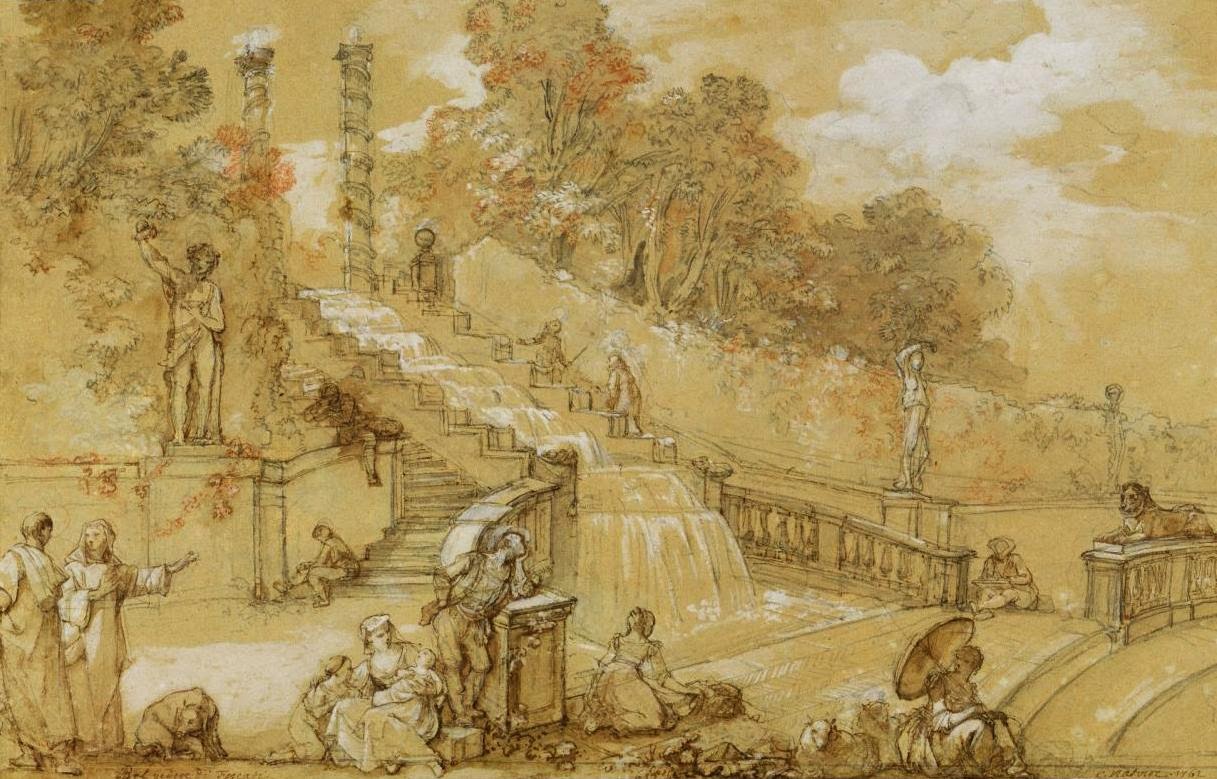
In the mid to later years of the rococo, one artist, Charles Joseph Natoire became director of the French Academy in Rome. Fond of landscapes and the importance of practising them, he encouraged his own students to do the same. The Cascade at the Villa Aldobrandini, Frascati is a beautiful example of a pen and ink landscape, shaded with brown washes. It is absolutely lovely.
![]() |
| Jacques Louis David 1748-1825, Study for Exécution des fils de Brutus. ca. 1785-1786, Pen and black ink with ink wash over black chalk, on laid paper. Thaw Collection, The Morgan Library & Museum. |
Revolution
Towards the end of the show, or the other side of the room as I viewed it, were some later works, including Jacques Louis David's Exécution des fils de Brutus. Now neoclassicism is clear, and we have moved a long way from the carefree gardens of Fragonard in style, but also in context.The drawing shows Brutus at the execution of his own sons. Brutus led a revolt against the last King of Rome and was a leader in creating the republic. His sons plotted to restore the throne, and upon discovery he oversaw their executions. A grave subject yet compelling image. How far we have come indeed.
If you will not be in town before January, you can see selected works from the show (including all of the above images) on the Morgan's website. The Morgan Library and Museum is on Twitter and updates often with events and fun links:@MorganLibrary (I am @MarieGossip1.) So who is going to the show?
Art, du jour! Sentimental style
Well that is the popular style, sentimental. If you want to be painted, you want to chose an artist who is at the height of fashion and popularity. And preferably someone who will make you look angelic, fresh, romantic and dare I say, human?
You know, the type of portraits where people are weeping over their dead pets.
"My poor beloved hamster is gone!"
"Oh my god my guppy is dead!"
Greuze was rather successful by employing this style and by 1777 he was selling works at auction for incredible amounts of money! A modern day Kinkade? Pshht. Better!
In fact, his sweet and endearing painting titled Little Girl Holding a Dog sold at auction for 7,200 livres in 1777. Later in 1802 it sold for 6720 pounds to Lord Dudley. The sentimental value was due to the dog, the dog was dead!
Subscribe to:
Posts (Atom)