 |
Louis Nicolas de Lespinasse (1734–1808), View of Two Banks of the Seine, Paris. Pen and brown ink and watercolor, heightened with white, over preliminary drawing in graphite; fine ruled border in pen and black ink. The Morgan Library & Museum.
|
The Morgan Library & Museum is now showing
Rococo and Revolution: Eighteenth Century French Drawings, and it is on display until January 3, 2010. This past weekend I had the chance to check out the show featuring works from the Morgan's permanent collection. The artists varied from Watteau, Boucher, Fragonard (tempted yet?) Greuze, Drouais and David.
 |
| Jean-Honoré Fragonard (1732–1806), Interior of a Park: The Gardens of Villa d'Este. 18th century, Gouache on vellum. Thaw Collection, The Morgan Library & Museum. |
It is downstairs in the Morgan Stanley East Gallery across from their Blake exhibition (also open until January 3). The whole exhibition is in one room set up with display cases down the center, holding plenty of pieces. I was immediately excited to see Fragonard's
The Gardens of Villa d'Este and of course the Watteaus!
The fabulous rococo.
The style developed during the reign of Louis XIV and the exhibition covers the end of his reign through that of Louis XVI, until neoclassicism was favored at the wake of the Revolution. The journey from the Sun King to Louis XVI is described through drawing. The show begins with the rich, often irregular compositions of the rococo, made up of intricate and flowing line which forms space and figures. The imagery is very pleasing to the eye, lush landscapes, rolling alleys, private parties and innocent conversations. It is all very attractive.
 |
| Jean-Baptiste Oudry (1686-1755), Rendez-vous au carrefour du Puits du Roi, Forêt de Compiègne, or Le Botté du Roi. 18th century, Pen and point of brush and black ink and gray wash, over black chalk, heightened with white, on blue paper faded to light brown. The Morgan Library & Museum. |
Pomp and Ceremony
I was caught by a pen and brush drawing by Jean-Baptiste Oudry. The piece is called
Meeting at the Carrefour du Puits du Roi, Compiègne forest, or Le Botté du Roi (The Booting of the King). The King in question is Louis XV, and the ceremony (booting of the king) was common. Here we see Louis has stepped down from his coach and is having his boots put on so that he can mount his horse for the hunt. He is attended by his Grand Veneur (Grand Huntsman) on the left and a large party of hunters who watch with apparent delight.
 |
| Detail. |
The booting of the King was a ceremony and those who had the privilege of chambre entree could attend. Typically le Botté du Roi occurred when the King changed his coat on his way to or from a hunt/walk. If you were of appropriate family/status/background all you had to do was ask the first gentleman of the chambre if you could attend. He could allow up to five suitable persons in, so you would need to get there early!
Versailles
 |
| Jacques Rigaud (1681–1754), Les Dômes. 18th century, Black chalk, pen and gray ink, gray wash. The Morgan Library & Museum. |
 |
| Les Dômes today. Unknown photographer, c 2009. |
Also on display among the drawings is a volume of a series:
Recueil choisi des plus belles vues des palais, château, et maisons royales de Paris et des environs by Rigaud. The book contains images of some of the most beautiful sights at Versailles by Rigaud, who was a talent at topographical scenes. The Morgan displays Les Dômes, which was created in preparation for the book. As noted on the website, this image let's us see what is no longer there, the two marble pavilions. And, of course, all the silk.
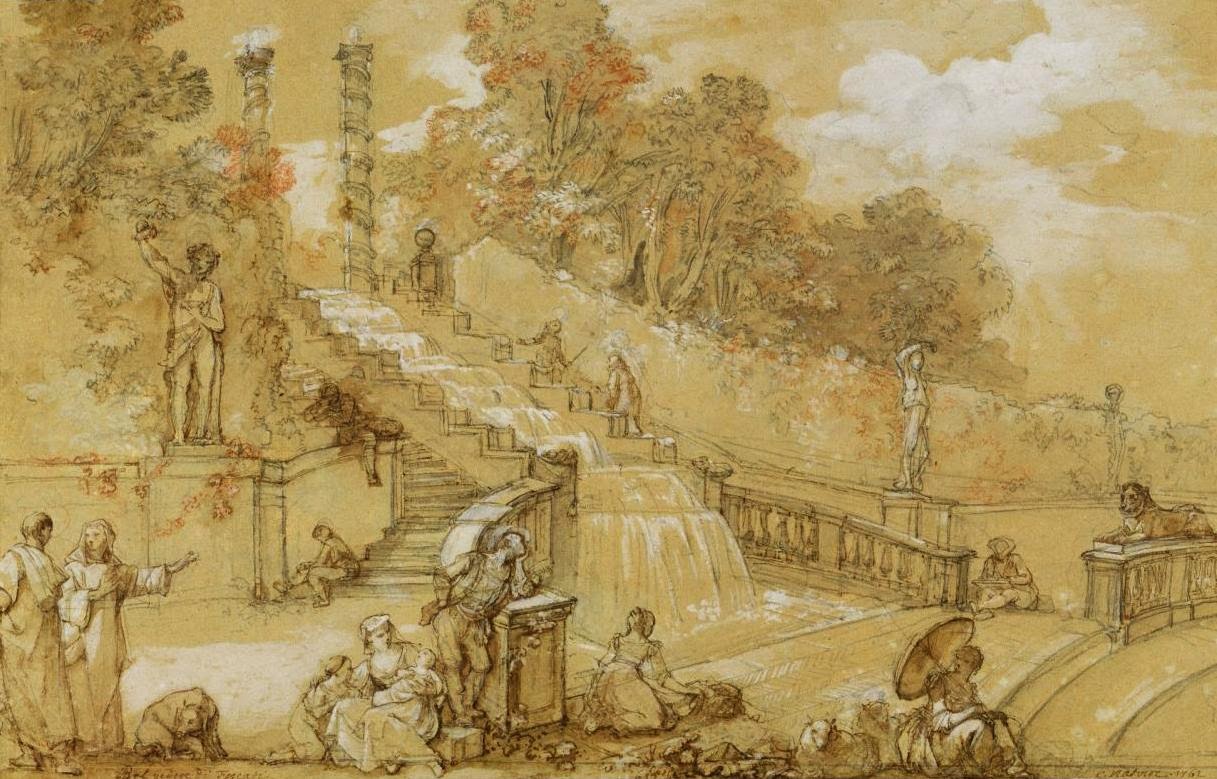 |
| Charles Joseph Natoire, (1700–1777), The Cascade at the Villa Aldobrandini, Frascati. 1762, Pen and brown and black ink, brown wash, black and red chalk, heightened with white, on light brown paper. The Morgan Library & Museum. |
In the mid to later years of the rococo, one artist, Charles Joseph Natoire became director of the French Academy in Rome. Fond of landscapes and the importance of practising them, he encouraged his own students to do the same.
The Cascade at the Villa Aldobrandini, Frascati is a beautiful example of a pen and ink landscape, shaded with brown washes. It is absolutely lovely.
 |
| Jacques Louis David 1748-1825, Study for Exécution des fils de Brutus. ca. 1785-1786, Pen and black ink with ink wash over black chalk, on laid paper. Thaw Collection, The Morgan Library & Museum. |
Revolution
Towards the end of the show, or the other side of the room as I viewed it, were some later works, including Jacques Louis David's
Exécution des fils de Brutus. Now neoclassicism is clear, and we have moved a long way from the carefree gardens of Fragonard in style, but also in context.
The drawing shows Brutus at the execution of his own sons. Brutus led a revolt against the last King of Rome and was a leader in creating the republic. His sons plotted to restore the throne, and upon discovery he oversaw their executions. A grave subject yet compelling image. How far we have come indeed.
If you will not be in town before January, you can see selected works from the show (including all of the above images) on the
Morgan's website. The Morgan Library and Museum is on Twitter and updates often with events and fun links:@
MorganLibrary (I am @
MarieGossip1.) So who is going to the show?


